
Main Line
Buyers & Refinancers
Resources
Mortgage
Skipping the appraisal sounds like a time-saver and a money-saver. But when the valuation turns out to be wrong, the lender isn’t on the hook — you are.
By HM Hoffman & Co. Appraisers | Main Line & Greater Philadelphia, PA | 5 min read
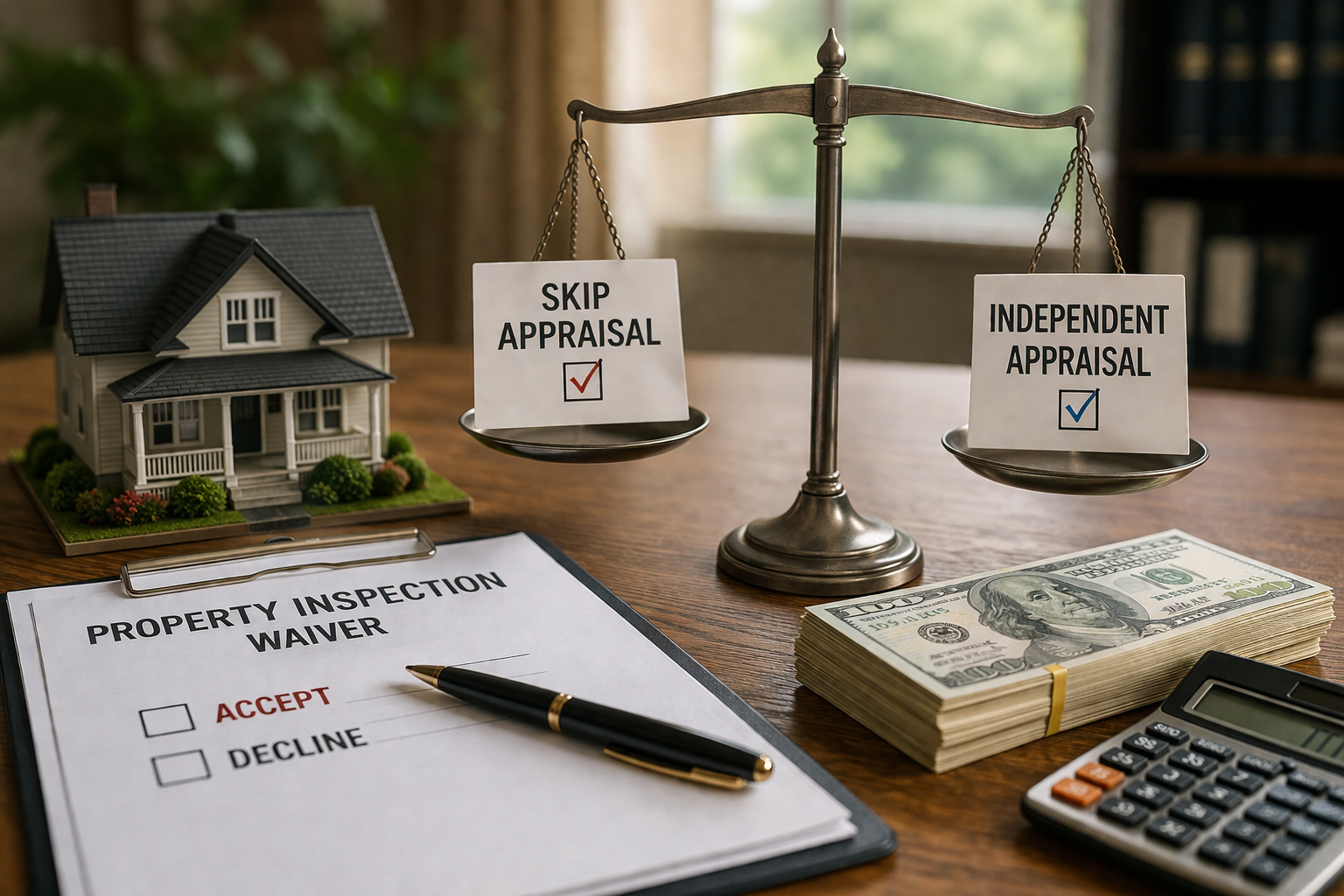
When you apply for a mortgage or refinance, your lender may offer you a Property Inspection Waiver — commonly called a PIW. On the surface it looks attractive: no appraisal fee, faster closing, less hassle. Some lenders present it as a perk, something you’ve “qualified” for based on your credit and assets.
What they’re less likely to volunteer is this: with a PIW, your lender assumes no liability if the computer-generated valuation turns out to be wrong. That risk transfers entirely to you. On a property worth hundreds of thousands of dollars — or more, on the Main Line — that’s not a small thing to wave away for the sake of a faster closing.
What a Property Inspection Waiver actually is
Introduced by Fannie Mae in 2017, the PIW program allows lenders to approve a mortgage without requiring a professional appraisal. Instead of hiring a local, licensed appraiser to inspect the property, the lender determines its value using a computer algorithm that pulls from Fannie Mae’s historical database of prior appraisals. No human visits the property. No one walks the rooms, notes the condition, or evaluates recent improvements or damage. A computer assigns a number — and that number becomes the basis for your loan.
Who qualifies for a PIW?
The program is not available to everyone. Your property must have an existing record in Fannie Mae’s electronic database — homes that have never been appraised are ineligible. You also need an excellent credit profile and significant assets. If your lender is offering you a PIW, it means you’ve met those thresholds. It does not mean accepting the waiver is in your best interest.
The risks a PIW creates for buyers and refinancers
The data is historical — not current
Fannie Mae’s database draws from past appraisal reports. That data may have been accurate at the time it was collected — but real property changes. Renovations add value. Deferred maintenance subtracts it. Storm damage, updated kitchens, finished basements, aging roofs — none of these are visible to an algorithm pulling from records that may be years old. A professional appraiser who physically visits the property sees what the computer cannot.
Your lender bears no liability if it’s wrong
This is the critical detail most buyers don’t fully absorb. When you accept a PIW and the property turns out to be overvalued, your lender is not responsible for the shortfall. You are. You’ve paid more than the property is worth, borrowed against an inflated value, and have no legal recourse against the institution that processed your loan using an algorithm instead of a licensed professional.
Selling later becomes a problem
If the computer overvalued your home when you bought it, that inflated figure becomes your baseline — and the market doesn’t care what an algorithm said. When you list the property, buyers’ appraisals will reflect actual market value. You could find yourself unable to sell for what you paid, with no way to recover the difference.
The Main Line market is hyperlocal — algorithms miss nuance
Property values on the Main Line shift significantly from one street to the next, one school district to another. The micro-market dynamics of Bryn Mawr, Haverford, Radnor, and Wayne require human judgment informed by local expertise — not a national database averaging broad regional trends. An algorithm simply cannot replicate what a certified local appraiser brings to the table.
The math is straightforward
A professional appraisal typically costs a few hundred dollars. The potential downside of accepting an inaccurate computer-generated valuation on a home worth hundreds of thousands — with no recourse against your lender — is orders of magnitude larger. In terms of risk management, commissioning an independent appraisal is one of the best-returning decisions a buyer or refinancer can make.
Don’t let an algorithm decide what your home is worth.
HM Hoffman & Co. provides certified, independent residential appraisals across the Main Line, Montgomery County, Delaware County, Bucks County, and greater Philadelphia. Whether you’re buying, refinancing, or simply want confidence that the number on your loan reflects reality — we’re here to give you exactly that.