
If you put less than 20% down on your home, you’ve probably been paying Private Mortgage Insurance every month since. Here’s how a current appraisal can get it canceled — and what to expect.
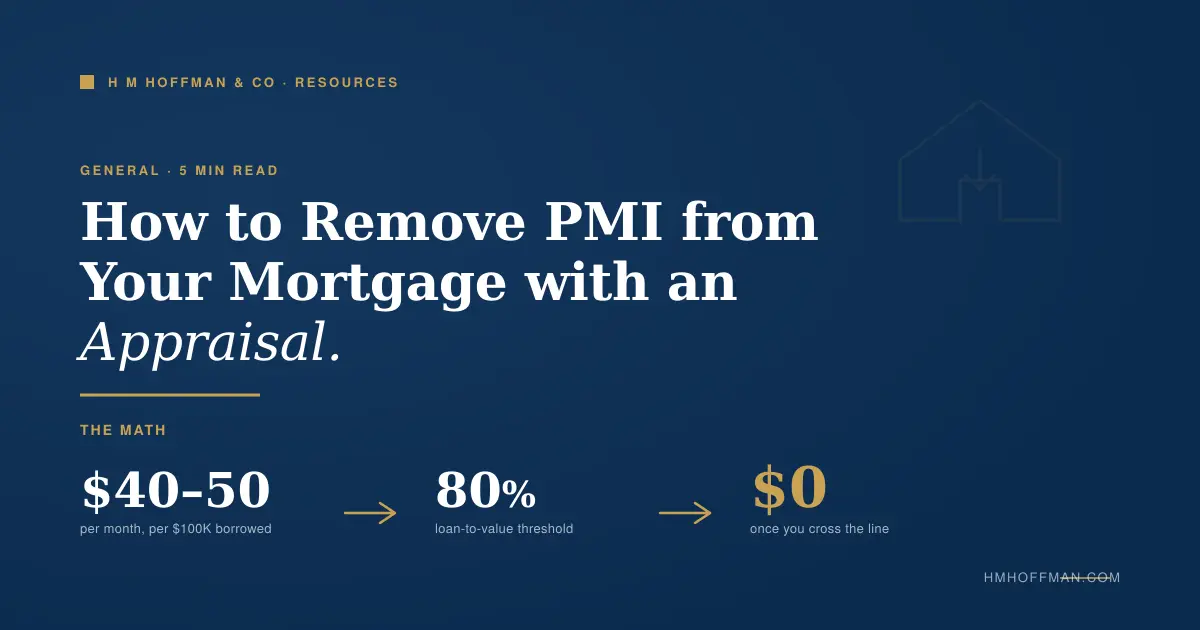
PMI is the cost of buying a house with less than 20% down. It protects the lender — not you — and runs roughly $40 to $50 a month per $100,000 borrowed. On a $400,000 mortgage that’s $160 to $200 a month, every month, until your loan-to-value ratio drops below 80%.
The good news: you don’t have to wait for that to happen by paying down principal alone. If your home has appreciated since you bought it, the equity you’ve built counts too. The catch is that you have to prove the new value — and that’s where an appraisal comes in.
First, a Quick Explanation of PMI.
A 20% down payment has historically been the standard on a mortgage because it gives the lender a buffer — if the borrower stops paying, the lender can foreclose, sell the home, and absorb the costs of the process without taking a loss.
During the mortgage boom of the 2000s, lenders accepted down payments as low as 10%, 5%, even zero. PMI was the workaround. The lender required Private Mortgage Insurance — paid by the borrower — to cover the gap between the actual down payment and the 20% they wanted to see. If the borrower defaulted and the home sold for less than the loan balance, PMI made the lender whole.
PMI is bundled into your monthly mortgage payment, which is why most homeowners don’t think about it as a separate line item. But it’s not part of your principal, it’s not part of your interest, and in most cases it’s not tax-deductible. Once you don’t need it, every dollar you stop paying is pure savings for the life of the loan.
The 80% Threshold — and the Two Ways to Cross It.
Under the federal Homeowners Protection Act of 1998, your lender is required to automatically cancel PMI when your loan balance reaches 78% of the home’s original purchase price. That’s the lazy path — it gets there eventually based on amortization alone, but eventually can be a long time.
The faster path: the same law requires the lender to cancel PMI upon your request once your loan balance drops below 80% of the home’s current value. Two ways that can happen:
Path 1 — You’ve paid down the principal.
Years of monthly payments have whittled the loan balance down to less than 80% of what you originally paid for the home. This is the path most lenders calculate automatically. No appraisal needed — your loan amortization tells the story.
Path 2 — Your home has appreciated.
The home is worth more than you paid for it, which means your loan-to-value ratio has dropped — even if you haven’t paid much principal yet. This is the path that requires an appraisal, because the lender doesn’t track your home’s current value on their own. You have to prove it.
For most homeowners on the Main Line and across greater Philadelphia, Path 2 is the faster route — sometimes by years. Real estate appreciation in this region has outpaced principal paydown for most of the last decade.
The Math: When Does an Appraisal Pay for Itself?
Take a homeowner with a $400,000 mortgage paying $180 a month in PMI. That’s $2,160 a year. An appraisal costs a few hundred dollars. If the appraisal supports cancellation, the report pays for itself in two to three months — and from month four onward, every dollar saved is yours.
Over the remaining life of a 30-year loan, that can add up to tens of thousands of dollars. The earlier in the loan you eliminate PMI, the bigger the cumulative savings.
How the Process Works.
-
01
Call your lender first.
Confirm three things: the current loan balance, whether they accept appraisals from any certified appraiser (most do, a small number have their own panel), and what their submission process looks like. Don’t order the appraisal until you’ve had this conversation. -
02
Order the appraisal.
You order it directly — not through the lender. The report has to be USPAP-compliant, prepared by a state-certified appraiser, and structured in the format lenders accept. Standard turnaround is 5 to 7 business days from inspection. -
03
Submit the report to the lender with a written PMI cancellation request.
The lender does the math: current balance divided by appraised value. If the result is below 80%, the law obligates them to cancel. If it comes back at, say, 85%, they don’t have to cancel — but they may agree to in some cases, or you wait until you’ve paid more principal. -
04
PMI is removed and your monthly payment drops.
Most lenders process the cancellation within 30 to 60 days of submission. Once it’s done, the savings show up on your next monthly statement and continue for the life of the loan.
When the Appraisal Won’t Help.
Worth being honest about: the appraisal only helps if your home has actually appreciated enough to push you below 80% LTV. A few situations where you might want to wait:
-
→
Your neighborhood has been declining or flat. Most areas in greater Philadelphia haven’t, but some pockets have, and your home is valued by its local market — not by national trends. -
→
You bought less than two years ago. Most lenders require some seasoning before they’ll consider an early PMI cancellation based on appreciation. -
→
You’ve added significant deferred maintenance or damage to the property since purchase. The appraised value reflects current condition.
If you’re not sure whether your home has appreciated enough to clear the threshold, a quick conversation usually settles it. I can give you an honest read on whether an appraisal is likely to support cancellation before you commit to ordering one.
Pennsylvania Only — Four Counties.
I handle PMI removal appraisals for homeowners across Philadelphia, Montgomery, Delaware, and parts of Chester County — within roughly 25 miles of my Narberth office. Licensed in Pennsylvania only. Not New Jersey.
Think you’re ready to cancel PMI?
Tell me what you originally paid, what you owe, and roughly when you bought. I’ll tell you whether an appraisal is likely to get you across the line — and quote a flat fee if so.